

Introduction
Engineered for extreme performance, Tungsten-Copper (WCu) alloy is a premium pseudo-alloy that masterfully combines tungsten’s exceptional heat resistance with copper’s superior electrical and thermal conductivity. Utilizing advanced powder metallurgy, this unique material offers outstanding arc erosion resistance, high strength, and a customizable thermal expansion coefficient. Whether for high-voltage electrical contacts, precision EDM electrodes, or advanced electronic packaging, CuW composite material delivers unmatched reliability and durability in the most demanding industrial environments.
What Is Tungsten Copper Alloy?
The definition of tungsten copper refers to a unique composite material composed of tungsten and copper. Because these two metals are mutually insoluble and do not form a true solid solution, the material is scientifically classified as a W-Cu pseudo-alloy.
This specialized structure is achieved through an advanced powder metallurgy process. During manufacturing, tungsten powder is first compacted and sintered to form a rigid, porous framework. Next, tungsten infiltration draws molten copper into the skeleton via capillary action, filling the voids.
This brilliant combination allows the material to perfectly merge the best properties of both elements: it inherits tungsten’s low thermal expansion, high hardness, and exceptional wear resistance, while simultaneously benefiting from copper’s superior electrical and thermal conductivity.


Key Properties & Benefits
🔥Arc Erosion Resistance
Exceptional durability in high-voltage environments, effectively resisting spark damage and wear in circuit breaker applications.
01
⚡High Thermal & Electrical Conductivity
Superior ability to rapidly dissipate heat and conduct electricity, ensuring stable performance under extreme thermal loads.
02
📐Low Thermal Expansion
A highly stable coefficient of thermal expansion (CTE) that perfectly matches semiconductor materials like Silicon (Si) and Gallium Arsenide (GaAs), preventing structural stress.
03
🔩High Hardness & Density
Outstanding mechanical tensile strength and structural integrity, making it an incredibly robust high-density material for demanding industrial use.
04
Standard Grades & Chemical Composition
| Grade | W / Cu Content | Equivalent Form Designation | Density (g/cm³) | Hardness (HB) | Thermal Conductivity (W/m·K) | CTE (×10⁻⁶/K) | Electrical Conductivity (%IACS) |
|---|---|---|---|---|---|---|---|
| CuW70 | 70W / 30Cu | W70Cu30 sheet & rod | 14.0 | 160 | 250 | 8.4 | 48 |
| CuW75 | 75W / 25Cu | 75W25Cu rod | 14.8 | 180 | 230 | 7.9 | 40 |
| CuW80 | 80W / 20Cu | W80Cu20 sheet | 15.5 | 200 | 215 | 7.6 | 35 |
| CuW85 | 85W / 15Cu | W85Cu15 sheet & rod | 16.2 | 230 | 195 | 7.2 | 30 |
| CuW90 | 90W / 10Cu | W90Cu10 sheet & rod | 16.8 | 260 | 175 | 6.8 | 25 |
Technical Specifications
| Property | CuW70 | CuW75 | CuW80 | CuW85 | CuW90 |
|---|---|---|---|---|---|
| W Content (%) | 70 | 75 | 80 | 85 | 90 |
| Cu Content (%) | 30 | 25 | 20 | 15 | 10 |
| Resistivity (µΩ·cm) | 3.6 | 4.3 | 4.9 | 5.7 | 6.8 |
| Thermal Conductivity (W/m·K) | 250 | 230 | 215 | 195 | 175 |
| Tensile Strength (MPa) | 480 | 520 | 560 | 590 | 620 |
| Yield Strength (MPa) | 330 | 360 | 390 | 420 | 450 |
| Elongation (%) | 4 | 3 | 2.5 | 2 | 1.5 |
| Young's Modulus (GPa) | 280 | 300 | 320 | 340 | 360 |
| Typical Applications | High-conductivity electrical contacts, resistance welding electrodes, spot welding tips, high-conductivity EDM electrode blanks | Resistance welding/projection welding electrodes, EDM electrodes, switch contacts, vacuum switch contacts | EDM electrodes, precision cavity electrodes, welding wheels/electrodes, arc-resistant contacts | High-precision EDM electrodes, arc-resistant contacts for high-voltage switches, molds, and wear-resistant parts. | High-voltage switch/circuit breaker contacts, extreme heat- and wear-resistant components, aerospace counterweights |
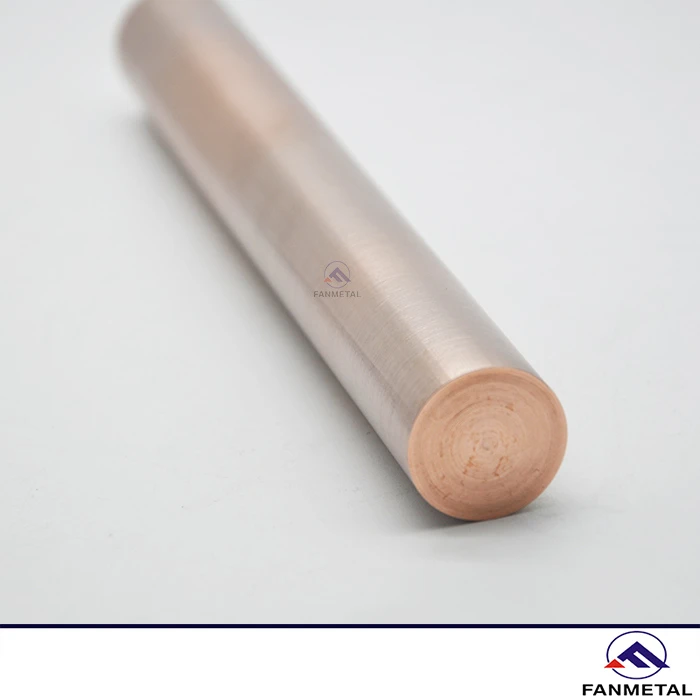
Diameter: Ø1.0 – Ø120 mm
Length: Standard 150 / 200 / 300 mm; customizable for greater lengths (up to 600 mm)
Surface: Turned or ground
Tolerance: Diameter ±0.05 – ±0.10 mm; Length ±1 mm

Thickness: 0.1 – 100 mm
Width × Length: 100×100 / 120×120, as well as 100×200 / 150×300, etc.
Tolerance: Thickness ±0.05 mm; flatness controlled according to thickness grade.

OD: Ø50 – Ø350 mm
ID: Ø20 – Ø100 mm
Wheel width (thickness): 10 – 100 mm
Typical specifications: 125 × 60 × 40 mm
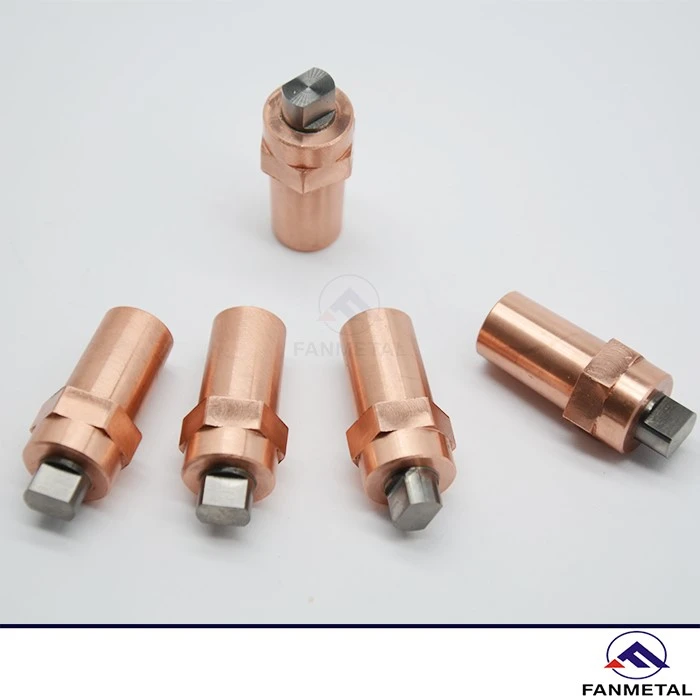
Copper Tungsten Inlaid Electrodes
Round rod with pointed tip: Ø3 / 5 / 8 / 10 / 12 / 16 / 20 mm × Length 20 – 100 mm
Square / Rectangular inserts: 5-50×5-50 mm, Height 5 – 100 mm
Square / Rectangular inserts: 5-50×5-50 mm, Height 5 – 100 mm
Custom-made according to drawings
Our Current Products & Forms


Common Applications & Industries


1. High Voltage Electrical Contacts & Power System Components
High-voltage electrical contacts are the most mature and widely applied scenario for tungsten-copper alloys. The material’s outstanding arc erosion resistance and stable electrical conductivity enable it to withstand frequent high-current switching and instantaneous high-temperature arc impact in power equipment. It effectively avoids contact ablation, fusion welding, and performance degradation, significantly improving the stability and service life of medium- and high-voltage power facilities.
- Medium & high voltage circuit breakers, vacuum interrupters, and power switchgear contacts
- Industrial contactors, power distribution switches, and electrical relay conductive components
- High-voltage isolation switches and arc shielding protective parts
2. EDM Welding Electrodes & Industrial Resistance Welding Parts
EDM welding electrodes and customized resistance welding components are among the most common industrial applications for tungsten copper alloys. Tungsten copper can be fabricated into standard rods, sheets, tungsten copper electrode wheels, and custom tungsten copper inlaid electrode products for diverse precision machining and welding scenarios.
The customized tungsten copper inlaid electrodes are specially designed for industrial spot welding and projection welding. The composite structure combines a high-conductivity copper base and a wear-resistant tungsten copper tip, perfectly adapting to inlaid electrode spot-welding working conditions, effectively reducing electrode wear and improving welding consistency.
- Precision mold EDM sinking, spark machining, and wire cutting with tungsten copper electrode blanks
- Seam welding, spot welding, and projection welding using finished tungsten copper electrode wheels
- Industrial stainless steel and galvanized sheet welding with custom tungsten copper inlaid spot welding electrodes
- High-precision finishing and machining of hard tungsten copper welding parts via professional PCD tooling
3. Electronic Packaging Heatsinks & Precision Thermal Management Parts
Electronic packaging heatsinks and heat spreaders are core functional applications of low-expansion tungsten copper alloys. Different from pure copper and pure tungsten, tungsten-copper composites feature high thermal conductivity and controllable low CTE, whose thermal expansion coefficient is highly compatible with semiconductor materials such as Si and GaAs.
- Heat sink substrates and packaging shells for IGBT modules, high-power semiconductors, and microwave communication devices
- Precision thermal management components for aerospace microelectronics, laser equipment, and RF devices
- High-stability heat spreaders for new energy automotive electronics and industrial control chips
4. High-Density Structural & Aerospace Industrial Components
As a typical high-density material, tungsten copper alloy integrates ultra-high mechanical strength, high-temperature resistance, and wear resistance, making it suitable for extreme industrial environments that require structural stability and durability.
- Aerospace vibration damping counterweights and high-temperature-resistant structural parts
- Vacuum equipment conductive and heat-conductive structural components
- High-precision instrument wear-resistant parts and micro-motor conductive brush holders
Tungsten Copper vs. Alternative Materials
| Pictures |
 |
 |
 |
 |
|
 |
| Material |
W-Cu (WCu20-WCu50) |
Pure Cu (T2 / C11000) |
CuCrZr (C18150) |
Be-Cu (C17200) |
Mo-Cu(MoCu20-MoCu40) |
Ag-W (ASTM B631) |
| Density (g/cm3) |
13.5-17.5 | 8.9 | 8.9 | 8.3 | 9.3-9.9 | ~13 |
| Melting / Softening (C) |
1083 / >800 | 1083 / ~320 | 1083 / ~480 | / ~480 | High/high | High |
| Electrical Cond. (%IACS) |
26-55 | 96-101 | 75-85 | 45-60 | ~50 | ~55 |
| Thermal Cond. (W/m.K) |
175-320 | 385-400 | ~320 | 105-220 | 155-220 | >300 |
| CTE (x10^-6 /K) |
6.5-11 | 16.5-17 | ~17 | ~17 | Adjustable from 5.6 to 13.5 | Low |
| Hardness (HB) |
115-280 | 70-80 | 130-150 | 200-250 | High | High |
| Arc & Heat Resist. |
Excellent | Poor | Moderate | Good | Good | Excellent |
| Relative Cost |
High | Low | Low-Mid | High | Mid | Very High |
| Best For | EDM Electrodes · High-Voltage Contacts · Electronic Packaging Heat Sinks | High-Current Conductive Components · Low-Load Electrodes | Medium-Power Spot Welding Electrodes · General-Purpose Conductive Components | Precision/Micro-welding Electrodes · Spring Contacts | Electronic Packaging Heat Sinks · Semiconductor Substrates | High-voltage vacuum switch contacts |

*Key Point: W-Cu is the only material that simultaneously offers a combination of high hardness and resistance to arc erosion, alongside low, tunable thermal expansion and high thermal conductivity. Tungsten provides strength and erosion resistance, while copper ensures electrical and thermal conductivity; their complementary properties create a performance profile that single-matrix copper alloys—such as pure copper or chromium-zirconium copper—cannot match.
Manufacturing & Processing Flow

Step1
Powder Proportioning & Uniform Mixing
Strictly proportion high-purity tungsten powder and copper powder according to different grades. Adopt professional ball milling and stirring technology to ensure uniform powder distribution, remove impurities, and avoid component deviation, which guarantees consistent physical performance of finished products.

Step2
Isostatic Pressing Forming
Put the mixed tungsten-copper powder into professional molds, and adopt cold isostatic pressing (CIP) or die pressing to form dense powder blanks. This process ensures uniform internal structure, stable density, and no internal cracks, laying a foundation for subsequent high-precision forming.

Step3
High-Temperature Sintering & Copper Infiltration
Place the pressed blanks in a high-temperature sintering furnace at 1300–1500°C for liquid-phase sintering and copper infiltration. The molten copper fully fills the porous tungsten framework to achieve high densification (≥99% density).

Step4
Rough Machining & Shaping
Remove sintered oxide layers and burrs, and perform preliminary turning, milling, and cutting to process the sintered blanks into standard rods, sheets, wheel blanks, and electrode blanks. Complete preliminary size calibration to reserve tolerance for fine machining.

Step5
Precision Finishing
According to product types, adopt targeted precision processing technology: Use PCD tool machining for high-hardness tungsten copper electrode wheels; complete grooving, chamfering, and assembly processing for tungsten copper inlaid electrodes to match spot welding usage requirements.

Step6
Surface Polishing & Deburring
Carry out fine polishing, sandblasting, and deburring treatment on the finished workpieces to remove tool marks and surface defects, improve surface finish, and effectively enhance arc erosion resistance and welding stability of electrical contact and electrode products.

Step7
Quality Inspection & Finished Product Packaging
Test key indicators, including density, hardness, thermal conductivity, electrical conductivity, and dimensional accuracy one by one. Qualified products are classified and packaged according to grades and specifications to ensure stable quality and batch consistency.
Why Choose FANMETAL
Our free service hotline:+8613140018814
All our tungsten-copper alloy products strictly adhere to the ASTM B702 international standard specifications.

Custom Machining & Fabrication Capabilities
FANMETAL is equipped with a full suite of CNC milling, precision grinding, and slow-feeding wire-cut EDM machinery. Working directly from customer-provided CAD, PDF, or STEP drawings, we offer a comprehensive one-stop service—spanning everything from raw material smelting to finished components—to precisely meet even the strictest tolerance requirements.
Quality Control & Testing Standards(ISO 9001)
Every factory batch must pass "four rigorous core tests": density balance testing, eddy current conductivity testing, hardness testing, and—most crucially—ultrasonic non-destructive testing (NDT). We guarantee the provision of an original manufacturer's MTC (Material Test Certificate) with every shipment.
Packaging & Delivery Details
Packaged in thickened, fumigation-free veneer cases, the items are securely positioned using high-density shock-absorbing foam and enclosed in vacuum anti-rust bags. We support air or sea freight, leveraging extensive global customs clearance experience to ensure timely and intact delivery to the customer's factory.
FAQ
Q: Can tungsten-copper alloy be machined with standard CNC tools?
A: Yes, but with limitations. While tungsten-copper (WCu) can be machined using standard CNC milling and turning equipment, its high hardness and abrasive nature require specialized tooling. We recommend using carbide, PCD (polycrystalline diamond), or CBN cutting tools to minimize tool wear. For high-tungsten grades (e.g., W80Cu20, W90Cu10), Electrical Discharge Machining (EDM) or wire cutting is often preferred for complex geometries.
Q: What is the difference between Tungsten Copper (WCu) and Molybdenum Copper (MoCu) for thermal management?
A: Both are excellent thermal management materials, but they serve different needs. WCu offers higher density and superior arc erosion resistance, making it ideal for high-voltage switches and EDM electrodes. MoCu, on the other hand, has a lower density and a slightly lower coefficient of thermal expansion (CTE), making it better suited for lightweight aerospace applications and electronic packaging where weight reduction is critical.
Q: How do you prevent cracking or edge chipping when cutting or drilling CuW alloys?
A: Edge chipping in CuW alloys usually results from excessive cutting forces or insufficient support. To prevent this:
Use sharp, wear-resistant tools and optimize cutting parameters (lower speeds, appropriate feed rates).
Apply high-flow water-soluble extreme pressure cutting fluids to dissipate heat effectively.
For drilling, ensure proper peck drilling cycles to clear chips and reduce load on the bit.
Avoid excessive impact forces during machining.
Q: Are your tungsten copper materials compliant with RoHS and REACH regulations?
A: Yes. Our tungsten copper alloys are manufactured using high-purity tungsten and copper powders without adding harmful sintering activators like Fe, Co, Ni, or Mn. All our standard WCu materials are fully RoHS- and REACH-compliant, ensuring safe use in electronics and sensitive environmental applications.
Q: Can Tungsten Copper be brazed or joined to steel or pure copper?
A: Yes, WCu can be successfully brazed to steel, pure copper, and other metals. Because the copper phase provides good solderability, standard silver-based or copper-based brazing alloys work well. For optimal joint strength and thermal conductivity, we recommend active metal brazing techniques or specialized surface metallization (e.g., nickel plating) before joining.
Q: What is FANMETAL’s standard lead time and MOQ for custom-shaped parts?
A: Our standard lead time for custom tungsten copper parts is typically 2 to 6 weeks, depending on the complexity of the tooling, required plating (e.g., Ni/Au), and part marking. The Minimum Order Quantity (MOQ) is highly flexible; we can accommodate low-volume prototypes as well as large-scale mass production runs. Please contact us for a specific quote.
Q: Can tungsten copper alloys be electroplated or surface treated?
A: Yes. To improve corrosion resistance, solderability, or electrical contact performance, WCu materials can be electroplated with nickel, silver, gold, or platinum. However, the material must be highly dense and free of porosity to ensure a smooth, uniform coating without metal grain shedding.

We're well-known as one of the leading tungsten copper alloy manufacturers and suppliers in China. If you're going to wholesale high quality tungsten copper alloy with competitive price, welcome to get quotation from our factory. Also, customized service is available.
resistance spot welding electrode, tungsten copper electrode wheels, Elkonite Tungsten Copper Alloy