

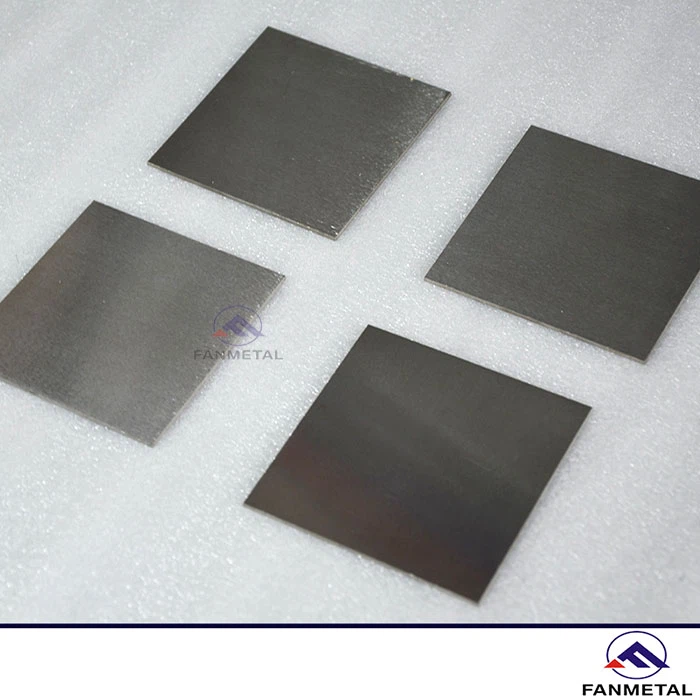


Tungsten Heavy Alloys Plates
Purity 90–97 wt.% W
Thickness 0.1 mm–50 mm
Width 2 mm–250 mm
Length Up to 500 mm
Density 15.8–18.75 g/cm³
Shape plate/sheet
Surface Ground, Polished, Machined
CustomizationSize, surface finish, machining available
Standard ASTM B777, GB
Send Inquiry
Product Details ofTungsten Heavy Alloys Plates
overview
Tungsten Heavy Alloy Plates are high-density materials made primarily from tungsten with nickel and iron or copper as binder elements. Common grades include WNiFe and WNiCu.Their high density, good mechanical strength, and ability to be machined into precise shapes make them suitable for applications where compact size, weight, or radiation attenuation is important.
FANMETAL supplies tungsten alloy plates in different tungsten contents, grades, dimensions, and surface conditions. Plates can be manufactured and machined according to customer drawings or specific application requirements.

Tungsten Alloy Properties
- High density, good ductility, excellent machining performance, high tensile strength
- Low coefficient of thermal expansion, high elastic modulus, high conductivity
- Excellent radiation shielding performance, good absorption of gamma and beta rays
- Strong corrosion resistance, good chemical stability, good wear resistance, and environmental protection and durability


WNiFe vs. WNiCu Tungsten Alloy Plate
| Grade | Main Characteristics | Typical Applications |
|---|---|---|
| WNiFe | Higher strength and hardness | Counterweights, shielding parts, structural components |
| WNiCu | Better ductility and electrical conductivity |
Shielding parts, electrical components, machined parts |
Manufacturing Process
Tungsten heavy alloy sheets are produced through powder metallurgy followed by rolling and machining. The main production steps include:
Powder Mixing
Pressing
Sintering
Rolling
Machining
Powder Mixing
Wolfram powder is mixed with nickel-iron or nickel-copper powders according to the selected alloy grade and required composition.
Pressing
The mixed powder is compacted into a preliminary shape under controlled pressure.
Sintering
The compacted material is sintered at a controlled temperature to form a dense tungsten heavy alloy structure.
Rolling
The sintered material is rolled to achieve the required plate thickness and improve dimensional uniformity.
Machining
The plates can be cut, ground, drilled, milled, or otherwise machined according to the required dimensions and tolerances. Surface quality can also be affected by the processing conditions.
For more information, see our guide to improving the surface quality of tungsten alloy processing.
We adjust the processing route based on the alloy grade, plate dimensions, tolerance, surface requirements, and final application.
Applications
Tungsten heavy alloy plates feature high density, high strength, and good machinability, making them suitable for applications requiring high weight, compact size, or radiation shielding capabilities.

tungsten alloy radiation shielding

Tungsten Alloy Counterweight

Tungsten Alloy Cube Weight
Radiation Shielding
The high density of tungsten heavy alloy provides effective radiation shielding in a compact size. Plates can be used in medical equipment, industrial inspection systems, and other radiation-related applications.
Medical Equipment
It can be processed into shielding and other components for medical equipment. Their high density allows effective shielding with relatively thin sections.
Aerospace
High density and good mechanical strength make W heavy alloy suitable for aerospace components where weight distribution and compact size are important.
Counterweights
Tungsten heavy alloy provides high weight in a small volume, making it suitable for counterweights and balancing components. WNiFe and WNiCu offer different combinations of density, strength, and machinability. For more information, see our comparison of W-Ni-Fe and W-Ni-Cu tungsten alloys.
Industrial Components
It can be machined into wear-resistant parts, counterweights, shielding components, and other industrial parts. Tungsten Alloy Cube is another option for applications that require a compact, high-density shape.
For applications requiring a high-density material as an alternative to lead, see our comparison of tungsten alloy and lead materials.
High-temperature Furnace
Thanks to their ultra-high melting points, high thermal conductivity, and excellent creep resistance, they can be used in hot zone systems for vacuum furnaces, equipment for growing sapphire and single-crystal silicon, MOCVD equipment, and structural components for high-temperature sintering and heat treatment furnaces.
Custom Tungsten Heavy Alloy Plates
Standard and custom plate sizes are available. FANMETAL can provide cutting, grinding, polishing, and machining according to the required dimensions. For special shapes or close-tolerance parts, customers can provide drawings for production review.
Please contact us with the required grade, thickness, dimensions, quantity, and surface finish.
FAQ
Q: What grades of tungsten heavy alloy plates are available?
A:WNiFe and WNiCu grades are available. The suitable grade depends on the required mechanical, machining, and electrical properties.
Q: Can you supply custom-size tungsten heavy alloy plates?
A: Yes. Custom dimensions can be produced based on customer drawings or specifications.
Q: What is the strongest tungsten alloy?
A: The strength of W alloys depends on composition, processing method, and application requirements. Tungsten heavy alloys such as WNiFe are commonly selected when high density combined with good mechanical strength is required.
Q: What is the difference between WNiFe and WNiCu heavy alloy plates?
A: WNiFe uses nickel and iron as binder elements, while WNiCu uses nickel and copper. The two grades differ in mechanical, electrical, thermal, and magnetic properties, so the appropriate grade depends on the application. For more details, see the W-Ni-Fe Vs W-Ni-Cu Tungsten Alloy Counterweight: How To Choose The Right One?
Q: Which is better, WNiFe or WNiCu?
A: WNiFe is generally selected when higher strength and hardness are required. WNiCu can be considered when better ductility or electrical conductivity is important.
Hot Tags: tungsten heavy alloys plates, suppliers, manufacturers, factory, customized, wholesale, price, quotation, for sale, Tungsten Alloys for Oil and Gas Industries, tungsten cubes, Tungsten Alloy Oil Counterweight, High Density Tungsten Counterweight, rivet bucking bar, Tungsten Alloy Counter Weight
Previous
Tungsten Bucking BarsSend Inquiry
