

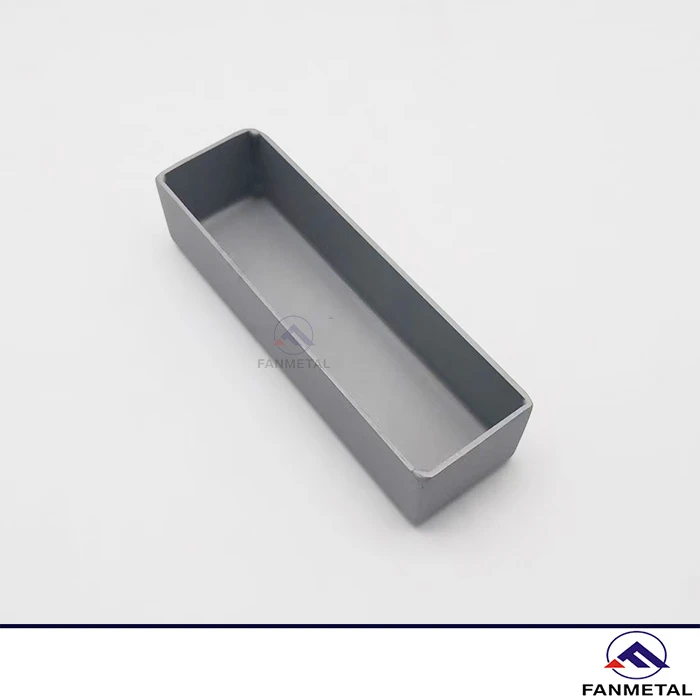

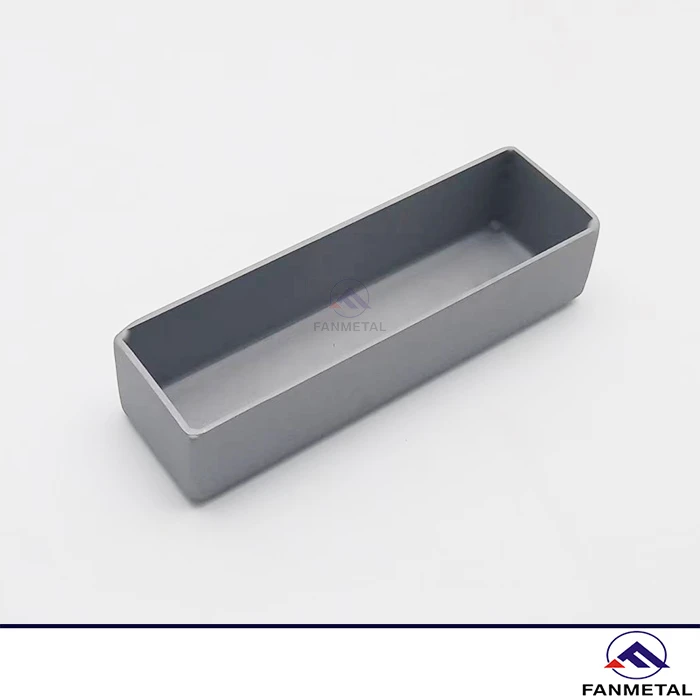
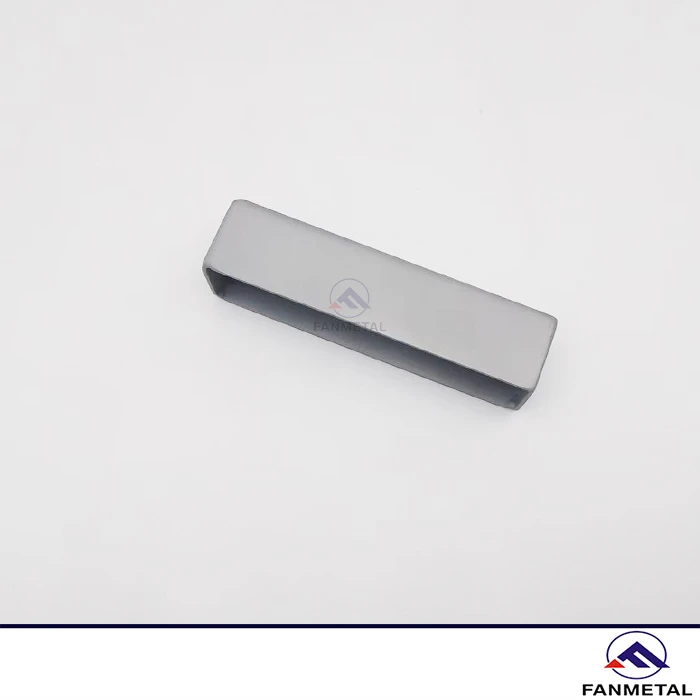
Molybdenum Boat Crucible
Thickness:0.3 mm-2.0 mm
Length:50 mm-200 mm
Width:10 mm-50 mm
Depth:10 mm-30 mm
Density:10.2g/cm³
Surface:Sintered/Polished/Grinding
Melting Point:2623℃
Standard:ASTM B386
Delivery Time:15-20 DAYS
Certification:ISO 9001
Send Inquiry
Product Details ofMolybdenum Boat Crucible
overview
Molybdenum boat crucible is essential consumables for high-end, high-temperature processes. They serve primarily as evaporation sources for vacuum coating-supporting aluminum and silver deposition for photovoltaics, optical lenses, and OLED screens-and are also utilized in high-purity metal smelting for semiconductors, sintering of cemented carbides and ceramics, single-crystal growth, and laboratory high-temperature heat treatment. Manufactured from molybdenum metal with a purity exceeding 99.95% through processes such as powder metallurgy, rolling, stamping, and electron-beam welding, these high-temperature-resistant, boat-shaped vessels come in various types-including stamped, folded, welded, and TZM alloy versions. They feature wall thicknesses ranging from 0.3 mm to 2 mm, with dimensions and perforation patterns customizable to specific requirements.
molybdenum boat Properties
Extremely high melting point
It has a melting point of 2623°C and can operate continuously at temperatures of 1700–2000°C in vacuum or hydrogen environments-far exceeding the capabilities of stainless steel or graphite-and is capable of withstanding the melting and evaporation of the vast majority of metals and oxides.
Stable thermal performance
It exhibits minimal dimensional change during high-temperature heating and cooling, offers excellent thermal shock resistance. It heats up rapidly when energized and maintains a low temperature gradient within the chamber, ensuring uniform heating of materials during evaporation and sintering, as well as consistent film thickness.
Excellent chemical inertness
It is extremely stable in vacuum or hydrogen environments, resistant to corrosion by molten metals, most acids and alkalis, and molten glass; furthermore, its impurity content is extremely low, ensuring no contamination of crystals or electronic components.
Strong processing & molding capabilities
Molybdenum sheet can be stamped, bent, riveted, and welded; it can be fabricated into V-shaped, flat-bottomed, elliptical, or spherical molybdenum boats, as well as machined into cylindrical or conical molybdenum crucibles to meet various material evaporation and melting requirements.
Type & Pictures
1. Classified by crucible type (specifically for evaporation coating)

Slotted Molybdenum Boat
Featuring an ultra-narrow slot and extended electrode plates, this boat is designed for vacuum deposition of small electronic components while effectively preventing molten material splash onto fixture electrodes.

Dimple Molybdenum Boat
Its single spherical deep-well design minimizes material usage for precise, waste-free evaporation of precious metals like gold and platinum in laboratory-scale coating applications.

Molybdenum Boats with Folded Edges
The center V-groove with widened conductive pads ensures stable evaporation for poor-wetting materials like gold and chromium, making it the industry standard for optical coatings and jewelry plating.
2. Classified by processing method (applicable to all scenarios)
Folded Molybdenum Boat
Creating by bending a rectangular sheet of molybdenum using a mould; usually comes with "ears" or extended ends on both sides for clamping and electrical connection purposes. The center area is designed in a way that enables it to house evaporation materials like aluminum or palladium etc. Comes with sharp corners and wounded seams; seams are created by folding and not welding. The cost is low as well as the process is simple; particularly suited for mass production; involve no welding.
Stamped Boat
It has an exceptionally uniform wall thickness and a flat, smooth bottom surface that guarantees even resistance heating and prevents material splash due to localized hot spots. One-piece formation makes stress concentration points at folds absent, thus ensuring excellent creep resistance. This item is good for optical coating, vacuum metallizing, and sintering, among others.
Riveted Boat
Making of bent molybdenum plates with a thickness of 3–8 mm which are unified by means of rivets. Reliable and strong design with good load capacity; resistant to deformation. Utilized for vacuum sintering process of powder metallurgy materials, ceramics and rare-earth compounds.
Welded Boat
The manufacture of the component uses welding of thick plates made of molybdenum by means of argon arc welding. The design is leak-proof. The article can be utilized to produce items that bear a large load and come in appropriate dimensions. The component can be used even under high-pressure and high-temperature conditions.


3. Classification by material (determines high-temperature service life)
Pure Molybdenum
Suitable for long-term use at temperatures ≤1200°C; lowest cost. Ideal for intermittent low-temperature evaporation and short-term sintering; prone to softening and creep during prolonged high-temperature exposure.
TZM (Titanium-Zirconium-Molybdenum) Alloy Boat
Excellent high-temperature strength and excellent creep resistance; can be used in continuous operation at temperatures up to 1700–2000°C. Suitable for continuous production, high-temperature sintering and long-term coating processes; its lifetime is 2-4 times longer than that of pure molybdenum.
Molybdenum-Lanthanum (Mo-La) Alloy Boat
Superior toughness; better resistance to thermal cycling and high-temperature oxidation compared to pure molybdenum; less prone to cracking during repeated heating and cooling. Ideal for equipment requiring frequent start-stop cycles and operating conditions involving severe thermal shock.
Molybdenum-Rhenium (Mo-Re) Alloy Boat (High-End)
Retains ductility at low temperatures and offers the highest corrosion resistance; used for melting specialized reactive materials; high cost.
4. Selection Recommendations and Considerations
Select Material Based on Temperature:
Pure Molybdenum Boat (Mo1): Temperature resistance approx. 1100°C–1700°C; used for standard aluminum coating and rare-earth smelting.
Molybdenum-Lanthanum (MoLa) Alloy Boat / TZM Alloy Boat: Temperature resistance exceeds 1900°C; features high recrystallization temperature and superior resistance to sagging; used for high-temperature precision coating.
Select Structure Based on Process:
For cost-effectiveness and quick replacement → Choose Folded Boat
For superior coating quality and long service life → Choose Stamped Boat
Storage Note: Molybdenum boats should be stored in a vacuum or dry environment to prevent oxidation and moisture absorption, which can compromise electrical conductivity and service life.
Application


1. Vacuum Coating Sector
Molybdenum boats serve primarily as carriers for resistance-heated evaporation sources, holding coating materials such as gold, silver, aluminum, and chromium, as well as certain compounds. They are widely used in production scenarios ranging from optical and decorative coatings to functional thin-film applications. Currently, they are essential consumables in mass-production lines for mobile phone screens, optical lenses, glass coatings, decorative hardware, and plastic coatings, playing an irreplaceable role in vacuum thermal evaporation processes.
2. Powder Sintering Sector
Molybdenum evaporation boats are special containers used in the processes of vacuum sintering and heat treatment, allowing the powder materials to be sintered, alloyed, and densified. This equipment is widely used in the production of various powder metallurgy products such as cemented carbide tools, precision parts, etc.
3. Electronics and Semiconductor Industry
Molybdenum boats are suited for the precision manufacturing of semiconductor chips, molybdenum wafers, and electronic components. They are primarily utilized in critical processes such as Chemical Vapor Deposition (CVD), Physical Vapor Deposition (PVD), wafer annealing, component sintering, and degassing treatments.
4. Laboratory and Scientific Research
Molybdenum boats are special instruments that are used in various high-temperature laboratory techniques. They are typically used to perform evaporating processes, melt metals, sinter powdered materials, and perform different kinds of heat treatment in vacuum conditions. As they are able to hold a wide variety of materials including powders, nanomaterials, and other special chemicals, they are useful for many experiments in special conditions.
| Application areas | Common types | Key Performance Requirements | Typical material |
| Aluminum-plated packaging | Folded | High cost-effectiveness and quick replacement | Mo1 (pure molybdenum) |
| Optical precision coating | Stamped/Dimple | Uniform evaporation, no splash, long life | MoLa / TZM |
| Precious metal evaporation |
Butterfly/Narrow-gulched boat |
Good heat concentration and precise control of small doses | Mo1 / W-Re |
| Cemented carbide sintering |
Welded/Flatbed boats |
Large load bearing, deformation resistance, large size | TZM / Mo-La |
| Tantalum capacitor sintering |
Pumpboats/Custom Shaped Boats |
Ultra-high purity, pollution-free | Mo (>99.95%) |
| Rare earth smelting | Thick-walled welded boat | Resistant to erosion and thermal shock | Mo-W Alloy |
Processing
Hydrogen reduction of ammonium molybdate to molybdenum powder → Mixing (alloying additions) → Cold isostatic pressing → High-temperature hydrogen sintering → Hot rolling → Cold rolling → Intermediate annealing → Alkaline descaling → CNC sheet cutting → Four-side bending/forming → Vacuum electron beam welding → Weld grinding and flaw detection → Punching/Milling → High-temperature stress-relief annealing → Mirror polishing → Ultrasonic cleaning → Dimensional quality inspection → Vacuum moisture-proof packaging

fAQ
Q: What materials can be safely evaporated using molybdenum boats?
A: They are ideal for evaporating aluminum (Al), gold (Au), silver (Ag), copper (Cu), and nickel (Ni) due to excellent wettability and thermal conductivity. However, avoid evaporating iron (Fe), cobalt (Co), or platinum (Pt), as these materials form low-melting-point eutectics with molybdenum above 1,000°C (1,832°F), causing rapid boat failure. Always verify material compatibility in our [Evaporation Material Compatibility Chart] before processing.
Q: Do your molybdenum boats meet ASTM B387 and RoHS standards?
A: Yes. All our mo boats comply with ASTM B387 Type 364 (unsintered, wrought Mo) and are RoHS 3 & REACH compliant. We provide full documentation with every shipment:
- Mill Test Certificate (MTC) verifying chemical composition and density (≥10.1 g/cm³ / 0.365 lb/in³)
- Certificate of Compliance (CoC) for RoHS/REACH
- Dimensional inspection report (on request)
- Conflict minerals declaration
These certifications satisfy audit requirements for aerospace, semiconductor, and medical device manufacturers.
Q: Molybdenum boat vs. tungsten boat: Which should I choose?
A: Choose moly boats for better wettability, lower cost, and superior performance with aluminum and gold at temperatures below 1,900°C (3,452°F). Choose tungsten boats only when operating above 2,200°C (3,992°F) or evaporating materials that alloy with molybdenum.
Q: What custom shapes and dimensions are available for Mo boats?
A: We manufacture standard and custom metal boats in V-shape, U-shape, W-shape, dimpled, and flat-bottom configurations. Standard thickness ranges from 0.2 mm to 2.0 mm (0.008"–0.079"), with lengths up to 150 mm (5.9"). Custom specs supported:
- Tolerances: ±0.05 mm (±0.002") on critical dimensions
- Surface finish: Ra ≤0.8 μm (32 μin) as standard; polished to Ra ≤0.2 μm (8 μin) on request
- Purity options: 99.95%, 99.97%, or 99.99% Mo
- CAD-based prototyping with 5-day turnaround
Q: How do I extend the lifespan of my evaporation boat?
A: Maximize Mo boat life by following these 5 proven practices:
- Ramp heating slowly: Use a rate ≤100°C/min (180°F/min) to prevent thermal shock cracking.
- Avoid overheating: Stay ≥100°C (180°F) below the max rated temperature for your specific grade.
- Maintain vacuum integrity: Keep pressure <1×10⁻⁵ Torr to prevent oxidation and embrittlement.
- Prevent mechanical stress: Never force-fit boats into holders; ensure proper alignment.
- Clean residues promptly: Remove leftover evaporant after each run to avoid localized hot spots.
Q: Why is my molybdenum boat cracking or deforming during use?
A: Cracking/deformation is usually caused by thermal shock, contamination, or excessive current. Top root causes and fixes:
- Rapid heating/cooling: Always use controlled ramp rates (≤100°C/min / 180°F/min).
- Material incompatibility: Eutectic formation weakens grain boundaries. Verify evaporant compatibility.
- Oxidation: Exposure to air >400°C (752°F) creates brittle MoO₃. Ensure vacuum <1×10⁻⁵ Torr before heating.
- Mechanical misalignment: Stress concentrations occur if the boat is pinched in the holder. Check fixture tolerances.
- Impure feedstock: Contaminants accelerate recrystallization and grain growth. Use ≥99.99% pure evaporants.

Hot Tags: molybdenum boat crucible, suppliers, manufacturers, factory, customized, wholesale, price, quotation, for sale, Moly Pipe, Thermocouple Protection, Thermocouple Protection Sheath, thermocouple protection tubes
Send Inquiry
