

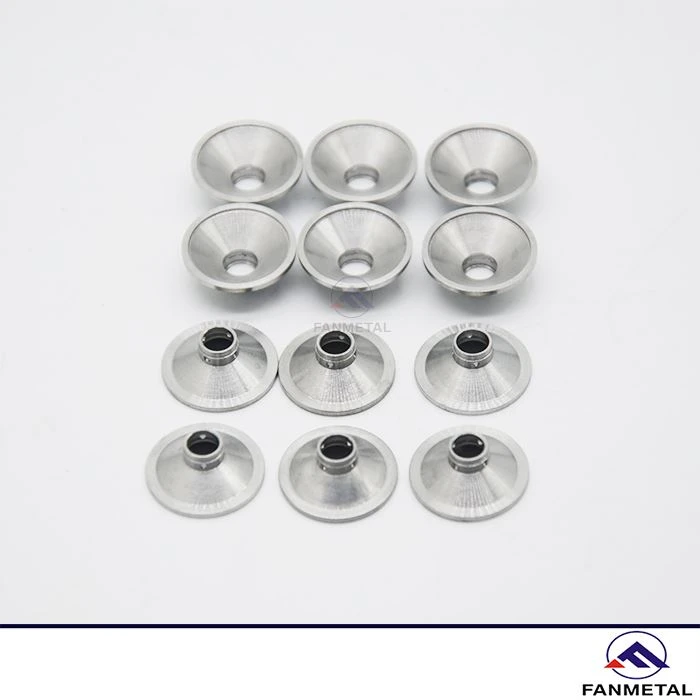

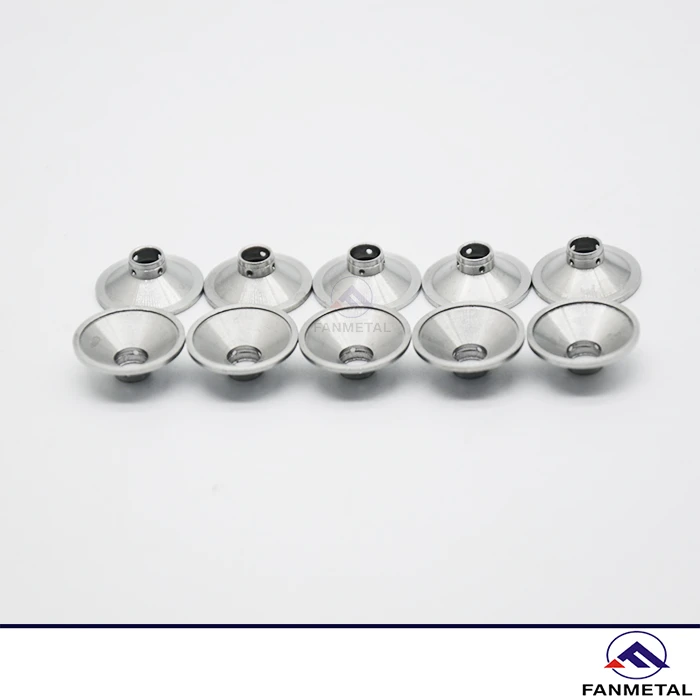
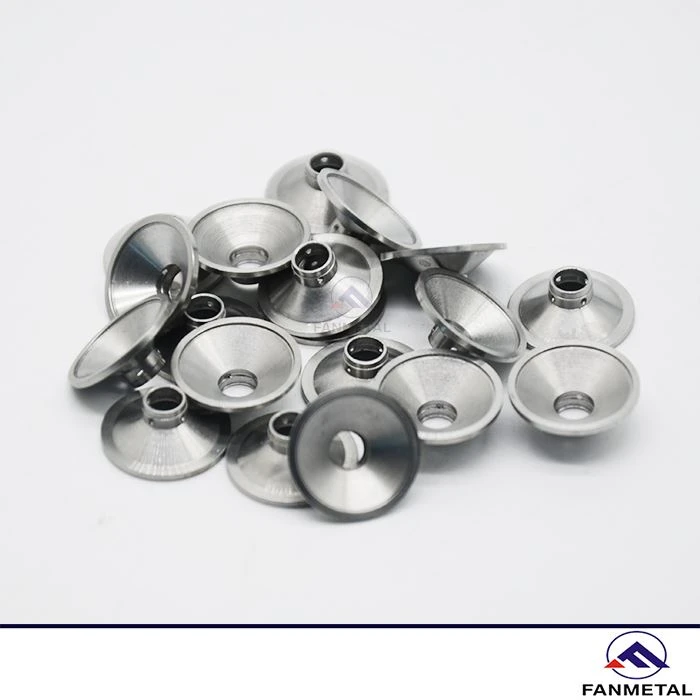
CNC Machined Molybdenum Parts
Purity:≥99.95%
Size:Customized
Density:≥10.15 g/cm³
Hardness:180-300 HV
Tolerance:±0.05mm-±0.10mm
Surface:Ra ≤ 0.2μm (Polished)
MOQ:10PCS
Standard:ASTM B387
Certificate:ISO 9001
Send Inquiry
Product Details ofCNC Machined Molybdenum Parts
overview
CNC Machined Molybdenum Parts are highly customized, deep-processed, shaped parts made of pure molybdenum or molybdenum alloys. Industrially, they are commonly used in specific tube assemblies, precision resistance welding (electrode heads/electrode bases), electro-optical sources, vacuum-coated heating elements, or specific glass fiber leak plate/nozzle assemblies, fully utilizing their excellent mechanical properties, conductivity, and durability.
As a non-ferrous metal supplier with over a decade of expertise in the production and export of molybdenum and molybdenum alloy products, FANMETAL also offers items such as molybdenum rods, molybdenum boats, and crucibles. If you are interested, please feel free to contact us via email.
Pictures


Features
High-temperature creep resistance and shape retention
It can maintain its geometric accuracy even in a vacuum or inert atmosphere at temperatures ranging from 1800°C to 2200°C and is less prone to collapse or deformation.
Outstanding thermal shock stability
It has a high thermal conductivity (~138 W/m·K) and a low thermal expansion coefficient (5.1×10⁻⁶/K), which means it is less likely to crack during rapid temperature cycles.
Advantages of heterogeneous structures
The thermal capacity is significantly reduced, enabling the heating element to heat up more quickly and providing a more sensitive temperature control response. At the same time, it also decreases the thermal load on the support structure.
Resistant to erosion by molten media
It exhibits extreme chemical inertness towards molten glass, liquid zinc/copper/gold, etc., without introducing impurity ions, thus ensuring the optical fiber's transmittance or the purity of the alloy.
- Compared to tungsten: machinability and rolling properties. Molybdenum exhibits good plasticity below the recrystallization temperature and can efficiently produce thin-walled rotary bodies through spinning, stamping, and deep drawing processes, resulting in high yield and low cost; Tungsten, on the other hand, is almost impossible to form plastically at room temperature, and large parts are easily scrapped.
- Compared to tantalum/niobium: higher cost-performance at high temperatures. Above 1600°C, the strength and creep resistance of tantalum/niobium drop sharply, requiring a significant increase in wall thickness before use, resulting in soaring costs and weight. Molybdenum maintains excellent mechanical properties within this temperature range, with a thin-walled design meeting requirements and a lower overall TCO.
Application


1. Vacuum tube assembly
CNC Machined Molybdenum Parts can be nested in precision electronic components such as special industrial electron tubes, vacuum tubes, microwave tubes, rectifier tubes, and emitter tubes, used to enclose protective cathode and anode components, while precisely restraining the movement trajectories of electron and ion beams. At the same time, the low vapor pressure characteristic of molybdenum prevents electrode material volatilization and contamination of the cavity during high-temperature operation, ensuring long-term stable operation of the tube.
2. Precision resistance welding field
The Molybdenum Cup Electrode is suitable for welding small parts such as chip pins, miniature connectors, and precision metal sheets. It can target special welding locations like irregular weld points, micro-raised components, and pipe ports, enabling wrap-type and fixed-point precise welding. The progressive funnel structure buffers welding pressure, preventing deformation of thin-walled and micro-workpieces under pressure.
3. Electric light source industry
Precision Molybdenum Components are mainly used in halogen lamps, xenon lamps, special industrial lighting sources, and vacuum ultraviolet light sources. They can nest filaments and light-emitting cores to provide fixed support, uniform heat conduction, and auxiliary arc excitation. This ensures a more uniform distribution of electric and temperature fields inside the light source, improving luminescence stability and service life.
4. Vacuum coating heating element
The Custom Shaped Molybdenum Electrode is the core heating and conductive component of vacuum evaporation coating and magnetron sputtering coating equipment. It can be adapted to the coating conditions of tubular and irregularly shaped workpieces, ensuring more uniform evaporation of coating materials and improving thickness consistency, effectively ensuring the precision and quality of high-end coating processes such as optical coating, hardware coating, and semiconductor coating.
5. Industrial fiber sector
This specially designed component can incorporate a dense micro-porous structure. Combined with its overall resistance to high temperatures and its ability to maintain its shape, it ensures that large quantities of ultra-fine glass fibers can be uniformly drawn. This improves the consistency and quality of the final glass fiber products. It is widely used in the industrial mass production of ordinary glass fibers, high-end ultra-fine glass fibers, and special glass fibers capable of withstanding high temperatures.
production process
① Raw Material Pre-treatment: High-purity molybdenum powder (purity ≥99.95%) is selected and subjected to screening, impurity removal, and drying. Powders with uneven particle sizes and impurities are discarded to ensure raw material purity, thereby guaranteeing the core performance characteristics-high-temperature resistance and stable electrical conductivity-right from the source.
② Shaped Molding/Isostatic Pressing: Specialized molds are custom-designed for various structures such as funnels, cups, and discs. Green bodies are formed via die pressing or cold isostatic pressing, accurately replicating the required complex profiles and ensuring dimensions and shapes meet design standards.
③ High-Temperature Hydrogen Sintering: The formed green bodies are placed in a hydrogen sintering furnace. A process involving staged heating, isothermal sintering, and gradient cooling is employed to densify the material, enhance overall strength and density, and prevent deformation during subsequent high-temperature use.
④ Precision CNC Machining: Based on blueprint specifications, precision turning, grinding, micro-hole machining, and shaping are performed on the complex profiles, wall thicknesses, apertures, and flat surfaces. This corrects minor deformations resulting from sintering and ensures compliance with precision industrial assembly and operational requirements.
⑤ Cleaning and Annealing: Ultrasonic cleaning and vacuum baking are used to remove surface oil and dust. Subsequent vacuum annealing eliminates internal stresses induced during machining, thereby enhancing the electrode's structural stability and fatigue resistance.
⑥ Dimensional and Performance Verification: Equipment such as CMMs (Coordinate Measuring Machines), calipers, and roughness testers is used to inspect dimensions, profile accuracy, and surface flatness. Simultaneously, product density, electrical conductivity, and high-temperature resistance are spot-checked to ensure only qualified products proceed.
⑦ Vacuum Packaging and Warehousing: Qualified products undergo dust-proof and oxidation-resistant vacuum packaging to prevent surface oxidation or discoloration during storage. This ensures product quality upon delivery and meets the precision assembly needs of various industries.
Quality Control & Inspection

We have established a rigorous, end-to-end quality control system featuring dual inspection protocols-covering both incoming materials and outgoing finished goods-to ensure uncompromising product quality. Our products are manufactured in accordance with the international standard ASTM B387. Every batch undergoes 100% dimensional inspection to eliminate size deviations and simultaneous ultrasonic flaw detection to comprehensively identify internal defects such as cracks, porosity, or looseness, guaranteeing a dense, flawless internal structure. Our facility is equipped with dedicated visual inspection stations.
Our core inspection equipment includes CMMs (Coordinate Measuring Machines), precision profile projectors, hardness testers, and surface roughness testers, enabling precise measurement of dimensional accuracy, flatness, hardness, and other performance metrics.
We hold ISO 9001:2015 quality management system certification. Each shipment is accompanied by an EN 10204 3.1 Mill Test Certificate (MTC) compliant with EU standards, ensuring full product traceability, standardization, and regulatory compliance.

FAQ
Q: What is the purity and material grade of your shaped molybdenum electrodes?
A: Our funnel/cup/disc shaped molybdenum electrodes adopt high-purity molybdenum powder with purity ≥99.95%, pure molybdenum grade, and no recycled materials. It features high temperature resistance, low vapor pressure, stable electrical conductivity, and excellent corrosion resistance to molten glass, which meets industrial vacuum and high-temperature working conditions.
Q: Can you customize funnel/cup/disc shaped molybdenum electrodes according to customer drawings? What is your precision tolerance level?
A: We support full custom processing of various special-shaped molybdenum electrodes, including irregular funnel, cup, and disc structures. Adopting CNC precision machining and gradient high-temperature sintering technology, we can control strict tolerances and avoid deformation.
Q: What is the service life of your shaped molybdenum electrodes under high-temperature and vacuum working conditions?
A: Thanks to high-purity raw materials and stress-relief annealing process, our electrodes feature stable high-temperature performance, no deformation, and no cracking under long-term high-temperature and vacuum environment. It effectively reduces replacement frequency, with a longer service life than ordinary molybdenum products, suitable for long-cycle industrial continuous production.
Q: What is your production lead time and acceptable payment terms?
A: For standard-shaped molybdenum electrodes, the lead time is 15–20 working days. For customized special-size electrodes, the lead time is 30–35 working days according to processing difficulty. We support flexible international payment terms, including T/T, Western Union, and L/C at sight, to meet different customers' trade requirements.
Q: Do you conduct a full inspection for each batch of shaped molybdenum electrodes? What tests are performed?
A: 100% full inspection is implemented for every batch. We perform 100% Dimensional Inspection to guarantee all size tolerances meet drawings, and Ultrasonic Flaw Detection to ensure no internal cracks, pores, or loose defects. Incoming materials and finished products adopt a double inspection mechanism to stabilize product consistency.
Q: What certifications can you provide? Can you offer official material test reports for each shipment?
A: Our factory is certified with the ISO 9001:2015 Quality Management System. Mill Test Certificate (MTC) according to EN 10204 3.1 is provided for every shipment, supporting full quality traceability and meeting European and American import standards.
Hot Tags: cnc machined molybdenum parts, suppliers, manufacturers, factory, customized, wholesale, price, quotation, for sale
Previous
Molybdenum Ion Implant PartsSend Inquiry
